


The Plaza Mayor in Salamanca is much more than one of the most beautiful squares in Spain. It is the true heart of the city and one of those places that virtually every traveller ends up visiting, even if it is simply to sit beneath its arcades and watch Salamanca go by.
But did you know that Plaza Mayor Salamanca is not a perfect square? That its four façades are not the same length? Or that its famous medallions actually tell part of the history of Spain?
Built in the 18th century, Plaza Mayor is one of the masterpieces of Spanish Baroque architecture and one of the finest examples of the work of the Churriguera family. Salamanca’s Old Town, of which the square forms part, was declared a UNESCO World Heritage Site in 1988.
If you want to discover the history, architecture and curiosities of Plaza Mayor Salamanca, keep reading. And if you would like to discover all its details during your trip, you can also join me on a guided tour of Salamanca.
The Plaza Mayor in Salamanca: the heart of the town
When you arrive in Salamanca for the first time, Plaza Mayor is very likely to be one of the first places you visit.
And that is no coincidence.
Plaza Mayor is located right in the historic centre and connects some of the city’s most important sights. From here, you can continue towards Casa de las Conchas, La Clerecía, the University of Salamanca and Salamanca’s Cathedrals. The Central Market, tapas bars and shops are also just around the square.
But above all, Plaza Mayor is still a meeting place.
Unlike other monuments that you visit and then leave behind, Salamanca`s Plaza is part of everyday life in the city. Locals, students and tourists pass through it every day, sit on its terraces, meet friends or simply cross it on their way somewhere else.
That is why it has become much more than a monument: it is one of Salamanca’s great spaces for social life.
It is the heart and centre of the city, and since its construction it has undergone various transformations before acquiring the appearance we see today.
When was Plaza Mayor in Salamanca built?
The Plaza Mayor we see today was built between 1729 and 1755, during the reign of Philip V.
Its construction was promoted by Rodrigo Caballero y Llanes, the corregidor, or royal representative, of Salamanca, who believed that the city needed a large public square surrounded by arcades.
The project was entrusted to the architect Alberto de Churriguera, one of the leading representatives of Spanish Baroque architecture.
Construction began in 1729 and the first sections of the square were completed relatively quickly. However, various problems involving property ownership and the construction of the buildings meant that the project took more than two decades to complete.
Alberto de Churriguera designed the first sections of the square. The work was later continued by other architects, including Manuel de Lara Churriguera, Alberto’s nephew, and finally Andrés García de Quiñones, who was responsible for completing the complex.
The works were finally completed in 1755.
And here we find one of the first curiosities about Plaza Mayor Salamanca: it was not built all at once, and not all four sides are exactly the same.
Why Isn’t the Plaza Mayor in Salamanca Square?
This is one of the things I often explain during my guided tours because, when you are standing inside the square, it is surprisingly difficult to notice.
According to Miguel de Unamuno, Plaza Mayor is an “irregular quadrilateral, but astonishingly harmonious.”
Its four sides are not exactly the same length, nor were they built according to a perfectly square geometric plan.
The square is organised into four large façades or pavilions:
- Royal Pavilion, on the eastern side.
- San Martín Pavilion, on the southern side.
- Petrineros Pavilion, on the western side.
- City Hall Pavilion, on the northern side.
The result is a completely enclosed square surrounded by arcades, with three storeys on its façades and a long succession of semicircular arches.
There is an important historical reason behind this irregular shape: the project had to adapt to buildings that already existed in the area, including the Church of San Martín.
This adaptation is precisely one of the things that makes Plaza Mayor Salamanca so interesting. It is not geometrically perfect, but visually it is extraordinarily balanced.
The Architecture of the Plaza Mayor
Plaza Mayor is one of the greatest examples of 18th-century Spanish Baroque architecture.
Its most characteristic feature is Villamayor stone, the same golden stone found throughout Salamanca’s historic monuments.
Have you ever noticed how the colour of the city changes when the sunlight hits it?
Villamayor stone takes on its distinctive golden colour, which has earned Salamanca its popular nickname, the Golden City.
In Plaza Mayor, this effect is particularly spectacular at sunset.
The façades consist of semicircular arches supporting the upper floors. The windows and balconies are arranged in a regular pattern, creating a sense of continuity all around the square.
But if there is one thing you should look at carefully, it is the spaces between the arches.
That is where you will find the famous medallions of Plaza Mayor Salamanca.
The Medallions of the Plaza Mayor
The medallions are probably one of the most fascinating features of the square.
If you simply walk across Plaza Mayor, it is easy to see them as little more than decoration. But if you look up and start examining them one by one, you will discover that they tell a genuine story of Spain.
The medallions depict different historical figures.
On the Royal Pavilion, you will mainly find Spanish monarchs. The San Martín Pavilion features figures connected with military history and the great Spanish conquerors, while the Petrineros Pavilion includes figures associated with culture and literature.
Among the people represented are figures such as Charles I, Alfonso XI, Ferdinand VI, Miguel de Cervantes and Saint Teresa of Jesus.
And there is something even more interesting: not all the medallions date from the time when the square was built.
They have been added gradually, and there is still room for new historical figures.
For example, in recent years Plaza Mayor has continued to receive new medallions. In 2023, one dedicated to Alfonso IX of León was installed. He was the king who founded the University of Salamanca.
The next medallion to be added will be that of Felipe VI, for which a project has already been prepared.
So the decoration of Plaza Mayor is not simply a look into the past: it continues to incorporate figures connected with the history of Salamanca and Spain.
The Royal Pavilion and Ferdinand III the Saint
One of the places worth stopping to look at is the so-called Royal Pavilion, located on the eastern side of the square.
At its centre, an important medallion dedicated to Ferdinand III the Saint.
Below it there are the medallions of Philip V and Elisabeth Farnese, the monarchs at the timePlaza Mayor was being built.
The decoration was not simply ornamental. The figures represented on the medallions conveyed a particular vision of the history of Spain, its monarchy and its most important historical figures.
That is why, when you visit Plaza Mayor Salamanca, it is worth taking a few minutes to look up.
Salamanca Town Hall
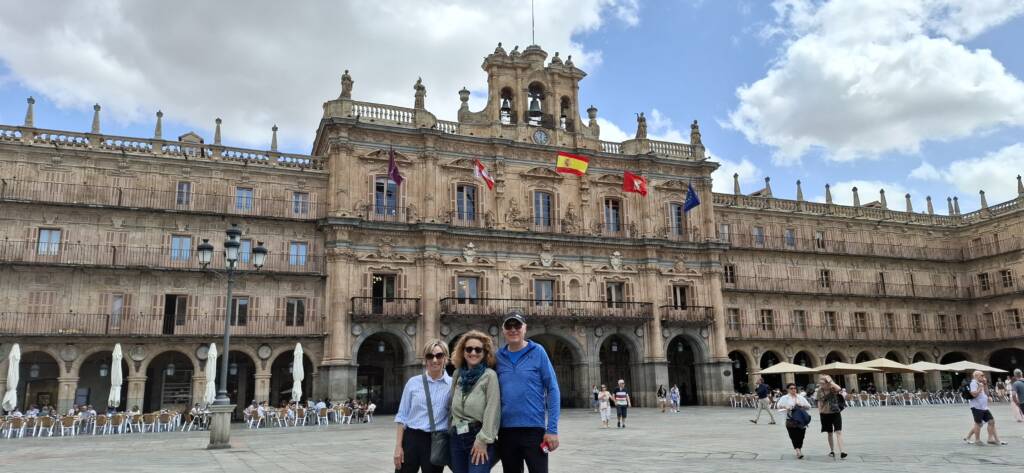
On the northern side of Plaza Mayor stands Salamanca Town Hall.

It is probably the façade that attracts the most attention, as the municipal building occupies the central part of the complex.
The Town Hall façade features five large granite arches and is topped by a spectacular bell gable.
Above it are the bells and the allegorical sculptures that crown the building.
The Town Hall was built under the direction of Andrés García de Quiñones, who played a key role in completing Plaza Mayor.
When you are in the Square, I recommend standing in the centre and looking directly towards the Town Hall.
It is one of the best places to appreciate how the Baroque decoration is concentrated on the main façade.
How Many Arches Does the Plaza Mayor Have?
One of the questions visitors often ask is how many arches Plaza Mayor has.
The answer is 88 arches.
These arches form the arcades around the square and create that characteristic sense of continuity which makes the four façades appear, when viewed from the centre, almost like a single building.
The balconies and upper floors are arranged above them.
And here is another interesting detail: each arch is associated with a decorative space and with the famous medallions, turning the arcades into a kind of gallery of historical figures.
The Plaza Mayor and Everyday Life in Salamanca
ince its construction, the Main Square in Salamanca has had many different uses.
It has been a meeting place, a venue for celebrations and performances, and the setting for important events in the life of Salamanca.
For a long time, it even had gardens and other elements inside the square.
The completely open appearance we see today is relatively recent.
Over time, some of these features disappeared, eventually leaving the open space we see today.
But one thing has not changed: Plaza Mayor continues to be Salamanca’s great meeting place.
That is why, if you really want to get to know the city, it is not enough to take a photograph and leave.
You should sit down for a while.
Watch the people.
Look at the buildings.
And simply let a few minutes go by.
That is when you understand why Plaza Mayor is much more than a monument.
La Mariseca: A Curious Salamanca Tradition
If you visit Salamanca during the summer, you may notice something rather unusual at the top of the Town Hall: La Mariseca.
It is a metal structure shaped like a bull which is placed on the bell gable during the town’s festivities. Traditionally, it signals the beginning of the celebrations.
It is one of those small details that many visitors overlook, but it is an important part of Salamanca’s traditions.
And it is precisely these kind of stories that make a guided tour different.
Because when you understand the meaning behind what you are seeing, the square stops being simply beautiful and starts to make sense.
What Is the Best Time to Visit the Plaza Mayor in Salamanca?
Plaza Mayor is worth visiting at any time of day, but there are several particularly interesting moments.
In the morning
The square is a great place to start exploring Salamanca. Depending on the time of year, you may find a quieter atmosphere before the city becomes busier.
In the afternoon
The activity increases and you can enjoy one of Salamanca’s most distinctive features: watching the Villamayor stone change colour as the light moves across the buildings.
At sunset
For me, this is one of the best moments.
The golden stone transforms in the changing light and Plaza Mayor takes on a very special atmosphere.
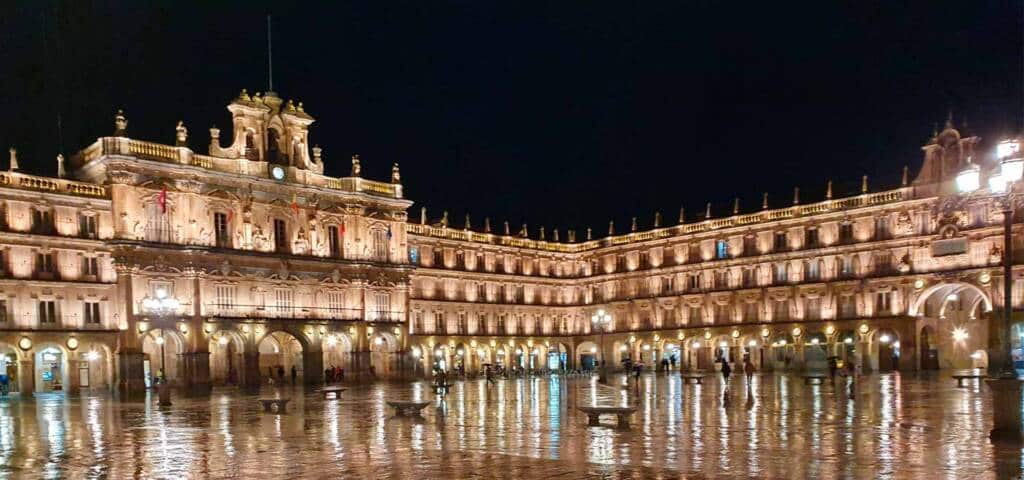
At night
The lighting completely transforms the space.
If you visit Salamanca, I recommend coming back to Plaza Mayor after dinner and seeing it illuminated. It is a completely different experience from visiting during the day.
What to See Near the Plaza Mayor in Salamanca
Salamanca’s Plaza Mayor is located in the heart of Salamanca’s historic centre, so from here you can easily walk to many of the town’s essential sights.
Just a few minutes away you will find:
- Casa de las Conchas
- La Clerecía
- University of Salamanca
- Anaya Palace
- Salamanca Cathedrals
- Monterrey Palace
- Church of San Martín
- Salamanca Central Market
If you are planning your trip, you can also read my article about what to see in Salamanca in one day, where you will find a route covering the town’s main monuments.
And if you would like to discover the history of the University, its buildings and its curiosities, you can read my guide to visiting the University of Salamanca.
Is It Worth Visiting the Plaza Mayor with a Guide?
The Plaza Mayor in Salamanca is one of those monuments that you can easily visit on your own.
But there is an important difference between seeing it and understanding it.
When you stand in the centre of the square, you can appreciate its dimensions, arches, balconies and decoration.
But a guide can help you discover things that you might otherwise overlook:
Who is the person represented on that medallion?
Why isn’t the square perfectly square?
Why is one of its sides called the Royal Pavilion?
What do the elements on the Town Hall bell gable represent?
Why does the stone have that distinctive golden colour?
And, above all, what is the connection between this square and the history of Salamanca?
On my guided tours of Salamanca, we explore the historic centre of the city and discover these details as we walk through its streets and monuments.
You can book a private tour of Salamanca, adapted to your pace and available in Spanish, English, French and Italian.
Frequently Asked Questions About the Plaza Mayor in Salamanca
When was the Plaza Mayor in Salamanca built?
It was built between 1729 and 1755, during the reign of Philip V. The original project was designed by Alberto de Churriguera, and the work was continued by other architects until its completion in 1755.
Who built the Plaza Mayor in Salamanca?
The project was designed by Alberto de Churriguera, one of the great architects of Spanish Baroque. Manuel de Lara Churriguera and Andrés García de Quiñones subsequently took part in the project, with García de Quiñones completing the works.
How many arches does the Plaza Mayor have?
Plaza Mayor has 88 arches, forming the arcades along its four façades.
What do the medallions in Plaza Mayor represent?
The medallions represent different historical figures, including monarchs, military leaders, conquerors and important figures from Spanish culture and literature. Their themes vary depending on the pavilion.
Is the Plaza Mayor in Salamanca Really Square?
No. Although it may look perfectly square at first glance, it is actually an irregular quadrilateral. Its four façades have different dimensions.
Is the Plaza Mayor in Salamanca Baroque?
Yes. It is one of the great works of 18th-century Spanish Baroque architecture and is closely associated with the Churriguera family. Salamanca’s Old Town was declared a UNESCO World Heritage Site in 1988.
What can you see near the Plaza Mayor in Salamanca?
From Plaza Mayor, you can walk within a few minutes to Casa de las Conchas, La Clerecía, the University of Salamanca, Anaya Palace, Salamanca’s Cathedrals and many other monuments in the historic centre.
One Final Recommendation: Take Your Time in the Plaza Mayor
There is one thing I always recommend to people visiting Salamanca:
Don’t rush through Plaza Mayor.
Take photographs, of course.
Look for the medallions.
Look at the Town Hall.
Pay attention to the Villamayor stone.
But, above all, sit down for a few minutes beneath the arcades and simply observe.
Because Plaza Mayor Salamanca is not just an 18th-century monument.
It is a place that is still alive.
And perhaps that is its most special characteristic: almost three centuries after it was built, Plaza Mayor continues to be the heart of Salamanca.
If you would like to discover Salamanca with me, take a look at my private guided tours or get in touch to arrange a tour adapted to your trip.
I look forward to welcoming you to Salamanca!
Keep reading: visit the University of Salamanca